A Thousand Nights, One Honest Moment: What That Song Finally Taught Me
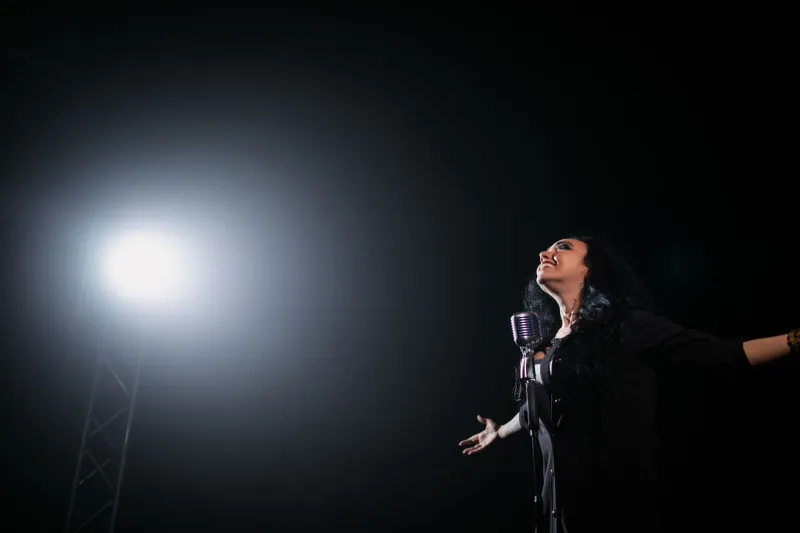
There's a version of me that exists in muscle memory. She knows every breath mark, every vocal run, every practiced pause before the bridge. She hits her light, she feels the crowd, she delivers. She is, by most measurable standards, a professional.
And for a long time, I confused that version of me with the real one.
The Song That Became a Script
I wrote that song — and I'm not naming it, because you probably know the feeling I'm describing better than you know the title — during one of those raw, ugly seasons of life. The kind where you're writing at 1 a.m. not because inspiration struck but because sitting with the silence was unbearable. It came out of me like a confession I hadn't planned to make. I remember finishing it and feeling almost embarrassed, like I'd said too much at a dinner party.
Then I performed it. And people responded. Like, responded responded. So I performed it again. And again. I built a set around it. I opened with it, closed with it, used it as the emotional anchor of entire tours. It became the song people requested, the one that showed up in comments, the one that justified a lot of things about my career that I was quietly unsure of.
Somewhere between performance 40 and performance 200, it stopped being mine.
I don't mean that in a dramatic, stolen-art kind of way. I mean it in the quieter, more insidious way — the way that happens when something sacred becomes scheduled. The lyrics were still technically true. The melody was still the same. But I was no longer inside the song. I was operating it, the way you operate a car you've driven so many times you can't remember the last time you actually looked at the road.
What Professionalism Can Cost You
Here's what nobody tells you about being a working artist in America: the industry rewards consistency in ways that can quietly punish authenticity. When you find something that resonates, you are expected — sometimes explicitly, sometimes through the soft pressure of booking agents and streaming algorithms — to reproduce that resonance on demand.
And you get good at it. That's the thing. You get really good at performing the feeling without having the feeling. Your voice breaks at the right moment. Your eyes go somewhere far away on cue. The audience cries, and you feel a complicated mix of gratitude and guilt, because you know you gave them the shape of an emotion without the substance.
I'm not proud of that period. But I'm also not going to pretend it didn't happen, because I think a lot of artists live there for longer than they admit.
The Night the Song Cracked Back Open
It was a Tuesday. Not a significant venue, not a milestone show — just a mid-size room in the Midwest, the kind of gig that exists in the middle of a run when everyone on the tour is a little tired and a little homesick and running purely on habit.
I started the song the way I always did. Intro, first verse, settle into the groove. And then I hit a line — a line I had sung easily a thousand times — and something about the way the room was lit, or the way I was feeling that particular Tuesday, or just the sheer accumulated weight of every time I'd skated past that lyric without really landing on it... it landed.
I'm talking about a full-stop, breath-caught, what-did-I-just-say moment. Right there on stage. In front of people.
The line wasn't new. I wrote it. But I heard it like I was hearing it for the first time — as something true, something that still applied, something that was actually about my life right now and not just the life I'd had when I wrote it.
I don't know if the audience noticed. I almost hope they didn't, because what happened in the next thirty seconds was between me and that song, and it felt private in a way that live performance almost never does.
What It Means to Show Up for Your Own Work
I've been thinking about that moment ever since, trying to understand what it was and whether I can get back to it intentionally or whether it only happens by accident.
Here's what I've landed on: repetition isn't the enemy. Disconnection is. And disconnection happens gradually, the way most losses do — not in a single dramatic rupture but in a series of small choices to go through the motions instead of through the feeling.
Showing up for your art isn't just about showing up to perform it. It's about staying in relationship with it. Asking what it means to you now, not just what it meant when you made it. Allowing the song — or the painting, or the book, or whatever your thing is — to be a living document instead of a finished product.
That's harder than it sounds when you're on night 47 of a run and your voice is tired and you'd genuinely rather be watching television in a hotel room. I know. I've been there. I am there, sometimes.
But I also know what it feels like when the connection is real — not performed, not approximated, but actual — and I know now that I'm not willing to go too long without it.
Still Learning This
I don't have a clean resolution here. I still perform that song. I still hit the same marks, more or less. But I try, now, to find the live wire inside it every single time — the part that still sparks, the part that still tells the truth about something.
Some nights I find it. Some nights I don't. But at least I'm looking.
And maybe that's the whole job, really. Not to be perfect. Not to be consistent. But to keep showing up like the song still matters — because the second you stop believing that, the audience will too.
They always know. They knew before I did.