I Could Fill a Room Before I Could Fill a Song
There's a version of me that existed for a long time — polished, rehearsed, magnetic even — who had absolutely no idea who she was.
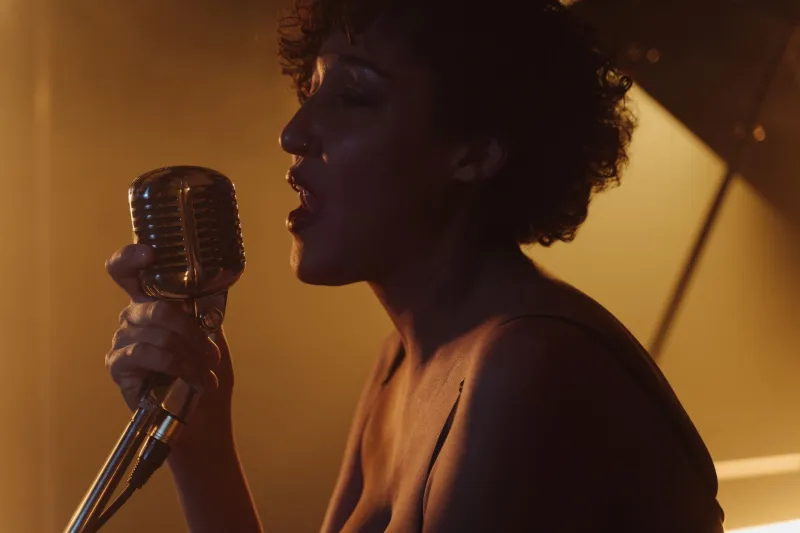
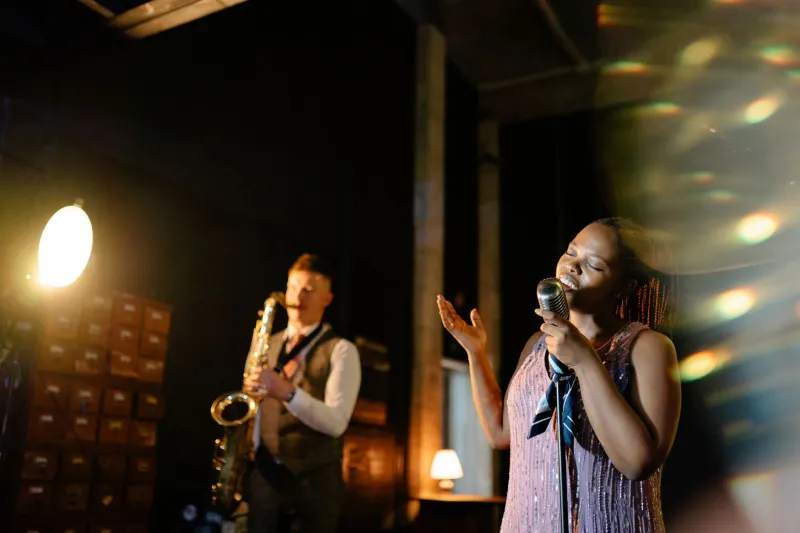
She could walk into a room and own it. She knew where to stand under the lights, when to lean into the mic, how to hold a pause just long enough to make the audience lean forward in their seats. She got standing ovations. She got callbacks. She got the kind of applause that rattles your chest from the inside.
And none of it was really her.
The Difference Between Performing and Expressing
I think a lot of us conflate these two things because they look identical from the outside. Performing is a skill. It's craft. You can learn it the same way you learn anything — repetition, feedback, refinement. And I was good at it early. Embarrassingly good, in hindsight, because that early competence gave me nowhere to hide.
When you're still figuring out who you are as an artist, being technically impressive is a trap. The applause tells you keep going, and so you do, and you get better and better at something that isn't quite yours yet. You're not lying exactly. You're just borrowing. I borrowed from everyone I loved — Lauryn Hill's cadence, Nina Simone's weight, Erykah Badu's refusal to be ordinary. I stitched them together and called it a sound.
For a while, it worked. For a while, I didn't notice the seams.
The Night I Heard the Echo
I remember the specific show where it cracked open for me. I was performing at a small venue in Atlanta — maybe 200 people, the kind of room where you can actually see faces — and I was mid-song, deep in a vocal run I'd practiced a hundred times, when I heard myself from the outside.
Not literally. But there was this split-second dissociation where I could hear exactly who I sounded like, and it wasn't me. It was an impressive approximation of three women who were not me, delivered flawlessly, to people who were genuinely moved.
And I felt nothing.
Not emptiness, exactly. More like the specific loneliness of being in a crowded room and realizing no one actually sees you — including yourself. The applause at the end of that song felt like a compliment delivered to the wrong person.
I smiled. I bowed. I went backstage and sat on a folding chair for a long time.
How Validation Becomes a Delay Tactic
Here's the thing nobody tells you about audience approval: it is genuinely wonderful, and it will absolutely slow you down if you let it.
Every time someone tells you that you're great, you have slightly less incentive to interrogate why or whether. The crowd's reaction becomes a shortcut your brain takes instead of doing the harder, quieter work of figuring out what you actually want to say. I spent years optimizing for other people's responses rather than my own creative instincts, and I got so efficient at it that I almost missed the window to do anything else.
I'm not being dramatic. I genuinely think another two or three years of that same path and I would have calcified into a version of myself that was successful and completely hollow.
The external validation wasn't evil. It was just louder than my own voice, and I hadn't yet learned to turn it down.
What Owning It Actually Felt Like
Finding your real artistic voice isn't a revelation. I want to be honest about that because every story about creative awakening sounds like a lightning bolt, and mine was more like a slow leak.
It started with discomfort. I began writing songs that I was genuinely afraid to sing — not because they were technically hard, but because they were specific. Specific to my childhood in a way that felt too small. Specific to my grief in a way that felt too raw. Specific to my body, my politics, my contradictions in a way that felt too risky to hand over to a roomful of strangers.
The first time I performed one of those songs, my voice shook. Not from nerves — I'd long since gotten over stage fright — but from exposure. There's a particular vulnerability in singing something that is actually, genuinely yours. Something that can't be traced back to an influence. Something that only exists because you exist.
The room was quieter than I expected. And then it wasn't.
The response wasn't bigger than what I'd gotten before. But it landed differently — in me, and I could tell, in them. There's a frequency that real stuff operates on that performance, no matter how skilled, just can't replicate. People don't always know why they're moved, but they feel the difference.
I felt it too, for the first time.
The Timeline Nobody Talks About
Performing ability and artistic identity develop on completely separate schedules, and the industry doesn't really account for that. We celebrate technical mastery early and often, which is fine, but we rarely create space for the slower, messier process of an artist actually becoming themselves.
I think about younger artists navigating this right now — the ones who go viral at 19, who get record deals before they've had enough life to write about, who are asked to be fully formed before they've had the chance to be confused. The pressure to arrive before you've actually made the journey is immense, and social media has made it about a thousand times worse.
I got lucky in some ways. My timeline was slow enough that I had room to fail privately, to write bad songs that never left my voice memos, to perform borrowed versions of myself until I got bored enough to look for something realer.
Not everyone gets that room. I think we should be building more of it.
What I'd Tell Her Now
If I could go back to the version of me sitting on that folding chair in Atlanta — the one who'd just gotten a standing ovation for a song that didn't belong to her — I'd tell her to sit there a little longer. To let the discomfort do its work. To stop reaching for the next performance and start reaching for the next truth.
The stage gave me a voice. But it took years — and a lot of uncomfortable honesty — to make it mine.
That's not a failure. That's just how it actually goes. And I think more of us should say so out loud.