I Held the Mic While Everything Else Was Falling
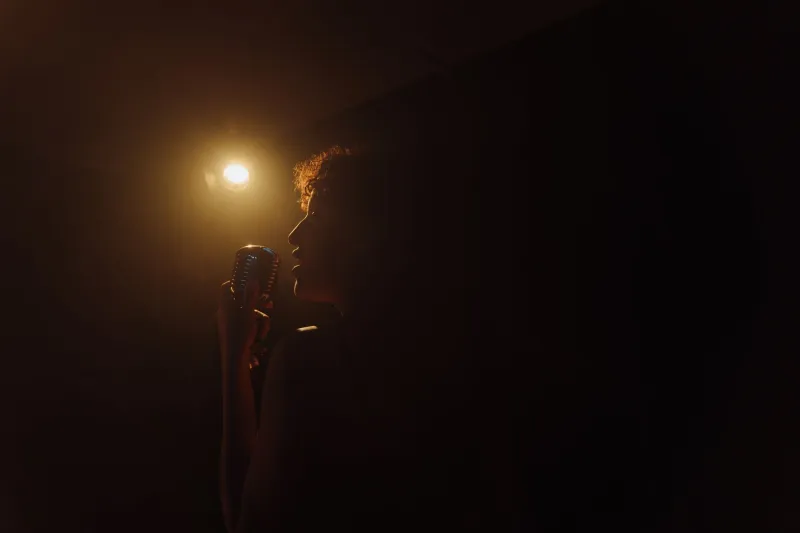
I remember standing in the wings, watching the stage crew adjust the monitor speakers, thinking: nobody out there knows. Nobody in that room had any idea that two hours before doors opened, I'd been sitting in a parking garage crying so hard I couldn't catch my breath. Nobody knew my phone had fourteen unread texts I was too scared to open. Nobody knew the thing I'd been privately dreading for months had finally, officially, arrived — and I had a show in two hours.
So I did what artists do. I went on.
The Ritual That Saved Me (And Also Lied to Me)
Every performer has some version of a pre-show ritual. Mine involves a specific playlist, a particular kind of quiet, and at least twenty minutes alone where I can just be before I have to perform. That night, the ritual felt hollow. I went through the motions — stretched, hummed scales, put on my stage look — but it was like watching someone else do it in a mirror. My body knew the steps. My mind was somewhere entirely different.
There's this thing that happens when you're in crisis and you still have obligations. Your nervous system splits. Part of you is white-knuckling through the present moment, doing what needs to be done. The other part is somewhere back in that parking garage, or three weeks in the future, catastrophizing. You become two people living in the same skin, and neither one feels fully real.
I've heard athletes talk about this. Surgeons. Emergency responders. That ability to compartmentalize isn't just a talent — it's a trained reflex. For performers, it gets reinforced every single time we step on a stage and make it look effortless. Every standing ovation teaches your brain: the split works. Do it again.
What nobody tells you is that the split has a cost.
What the Audience Saw
I've watched the footage from that night. Someone in the third row filmed it on their phone and posted it — grainy, slightly off-angle, but you can see my face clearly during the second song. I look alive. Not just present — genuinely lit up, the way I get when a performance is locking in and the room is breathing with you.
And I remember feeling that. I remember the song pulling me in like a current, remember the audience's energy meeting mine and creating something that felt bigger than either of us. For those four minutes, I was not a woman in crisis. I was just the music.
That's the strange, almost cruel gift of performance: it can temporarily dissolve whatever you walked in with. The stage doesn't care about your personal life. The song doesn't wait for you to be okay. You either surrender to it or you don't — and that night, I surrendered completely, because it was the only place I had left to go.
The Smile That Wasn't a Lie
Here's what I've been wrestling with ever since: was that performance authentic, or was it a mask?
For a long time, I told myself it was a mask. That I'd essentially deceived an audience — smiled through something real, packaged pain as entertainment, and called it art. That felt dishonest to me in a way that lingered.
But the more I sit with it, the more I think I had it wrong.
The song I performed that night — I'm not going to name it, but those of you who've been following me for a while will probably know which one — is about holding on when everything feels like it's slipping. I wrote it during a different hard season, and I'd performed it probably forty times before that night. I knew every word, every breath mark, every place where the melody dips and asks something of you emotionally.
But that night, I wasn't performing the memory of what the song meant. I was inside it in real time. The lyric about pretending you're fine in a room full of people? I wasn't recalling that feeling. I was living it, six feet from a microphone, in front of three hundred people who had no idea.
That's not a mask. That's the most honest I've ever been with an audience — they just didn't know the context.
What the Applause Couldn't Fix
I won't romanticize the rest of the night. After the last song, after the lights went down and I walked off stage, the split closed. Everything I'd been holding at arm's length rushed back in. I sat in the green room for a long time, still in my stage clothes, not talking to anyone.
The applause doesn't fix anything. I want to be real clear about that. There's a myth that performance is cathartic — that you pour it all out and walk away lighter. Sometimes that's true. That night it wasn't. The show had given me a two-hour reprieve, and I was grateful for it, but the crisis was still there waiting, patient as ever, right where I'd left it.
What I've come to understand is that those two hours weren't about escape. They were about proof. Proof that even in the middle of the worst thing, some part of me was still capable of showing up fully — still capable of connection, of beauty, of meaning something to the people in that room. That doesn't make the pain smaller. But it made me feel less like I was disappearing inside it.
The Question I Keep Coming Back To
I've been thinking about what it means to be a public artist during private collapse. We talk a lot, especially now, about authenticity — about bringing your whole self, being transparent, not curating a false version of your life. And I believe in that. Deeply.
But I also think there's a kind of truth that lives inside the performance itself, separate from disclosure. The audience that night didn't need to know what I was going through to receive something real from me. The realness was already there, embedded in the song, activated by what I was carrying — whether they could see it or not.
Maybe that's what art is, at its most fundamental: a container for experience that doesn't require explanation to land. You bring what you have. The song holds it. The room receives it. And somehow, in that exchange, something true passes between people — even when one of them is smiling through fire.
I don't have a clean ending for this one. Some nights on stage are triumph. Some are survival. That night was both, and I'm still figuring out what to do with that.